Finningley Amateur Radio Society
G0GHK - G7HAH - GB3FNY - GB3KEU
DONCASTER - IO93NN

G0GHK - G7HAH - GB3FNY - GB3KEU
DONCASTER - IO93NN
A simple self contained 10GHz 3cms monitor converter by G4HJW & G3AAF
With the advent of the low cost Quansheng UV-5R VHF/UHF hand-held portable and Egzumer software to both extend the receive frequency range and add USB reception, it has become possible to monitor narrow and wide band 3cm signals for as little as an additional £13, assuming a K-band satellite LNB is already to hand.
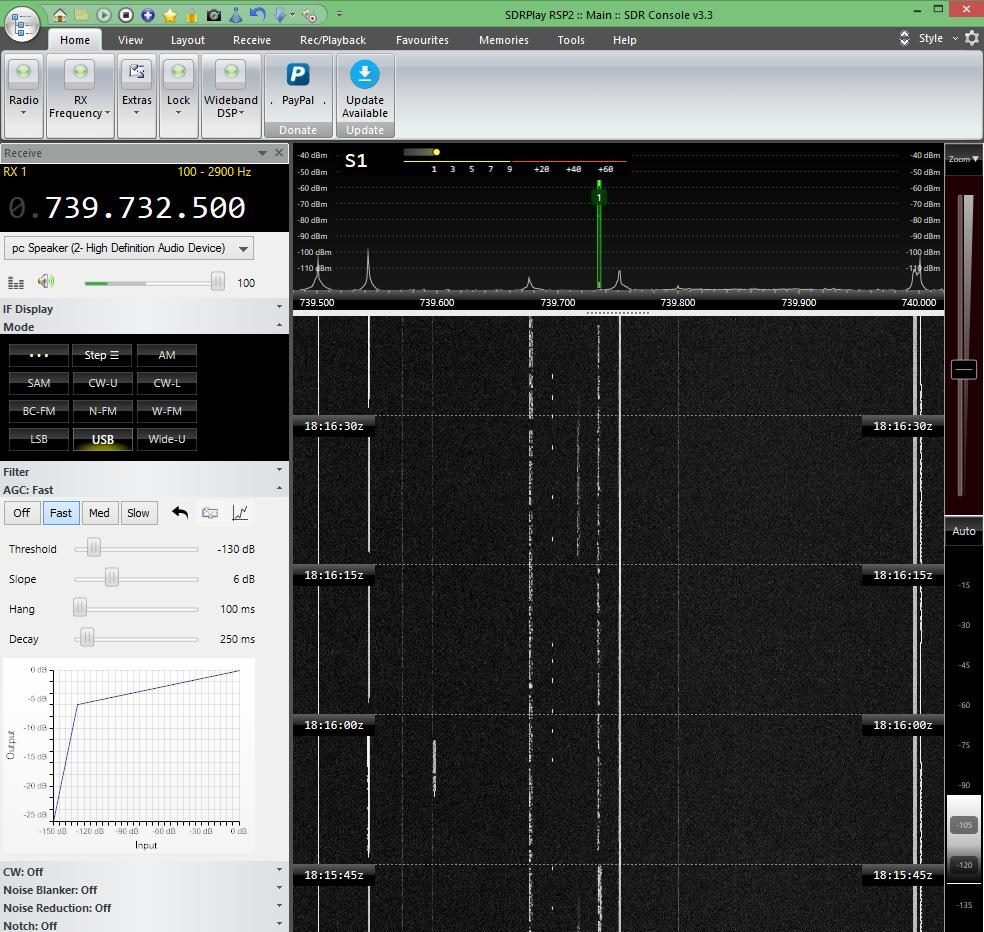
Fed from a signal generator, initial testing with the UV-5R set to 618.755 MHz (an LNB’s down-converted IF output frequency for GB3CAM) showed impressive frequency stability from the handheld - there was going to be no problem from this point of view in listening to SSB or CW.
A few single output LNB’s were then sourced via Aliexpress to see what was currently available. All were around £2 each and all were PLL based, as seems to be norm now. For testing, a tee piece was connected to the LNB, with one side connected via a 1m length of RG58 coax to a 12v power supply. No external decoupling at the PSU was used. Finally, a quarter-wave antenna was connected to the remaining tee piece port. At 618 MHz, the handheld background noise level on ssb could be heard to increase when the psu was switched on up to a distance between LNB and the hand-held of about 2m. Thus no direct connection between converter and receiver was going to be necessary in many monitor situations.
To make the converter fully self contained, the PSU was replaced with three series connected Li-ion 18650 cells fitted to a battery holder, with it and the LNB-antenna combination all mounted on a foam plastic base board. This assembly was demonstrated at last years Newark Hamfest by Kevin G3AAF on his stall, from which enough interest was shown to contemplate it becoming a build project for this years Finningley Round Table in June. A number of other converters were built along these lines, including a couple using ex vaping cells. That early work was written up here: http://www.earf.co.uk/easy3cm.html
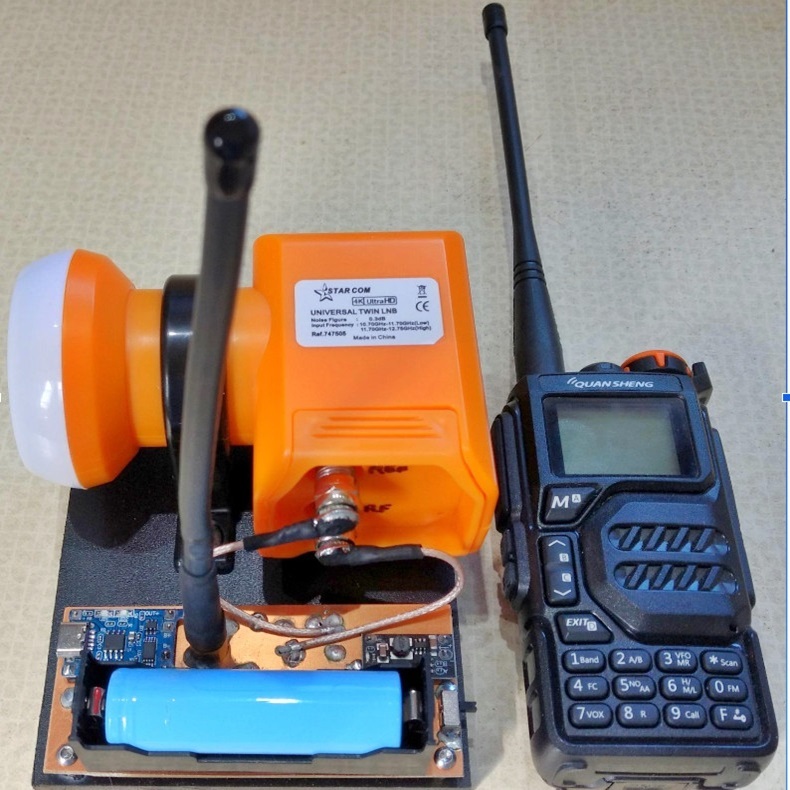
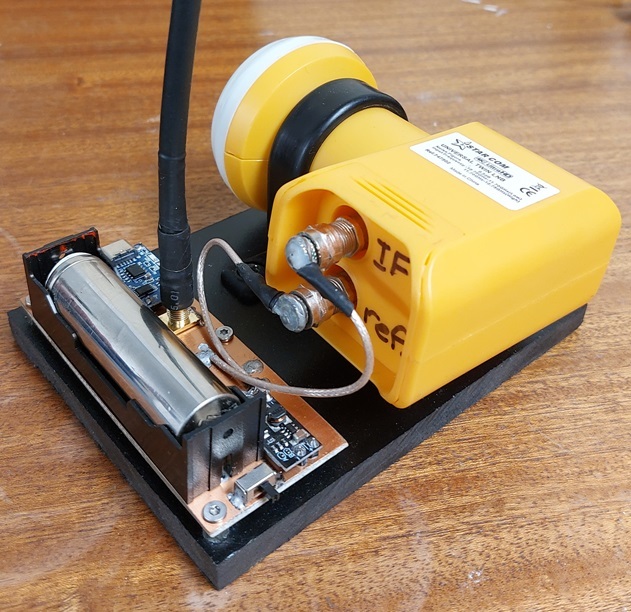
In considering a possible build project, a number of areas needed addressing, not least of which was the safety aspect and inconvenience of charging the three Li-ion cells of the initial build, especially as in removing them from the holder it was all too easy to short out a cell. Use of a single cell would solve any uneven charging problems and an on-board charging circuit would be preferable, not forgetting low volt drop-out to avoid early cell demise.
Wide-band noise output up to a couple of GHz radiated from the antenna seemed potentially anti-social, particularly above 618 MHz, though a low pass filter would easily fix this. A lesser issue perhaps was the poor LNB LO frequency drift performance. Initially, the thought was to have the option of fitting a tcxo based LNB, but their relatively high cost was rather contrary to the low cost aspiration of the project. Searching through Aliexpress, a dual output LNB was found at just £4 and a 25 MHz tcxo (suitable for the RDK3567EM LNB PLL chip) at £1.25. The project would inevitably need a pcb, so space would be available on that if the tcxo was found to be stable enough, which it very much was.
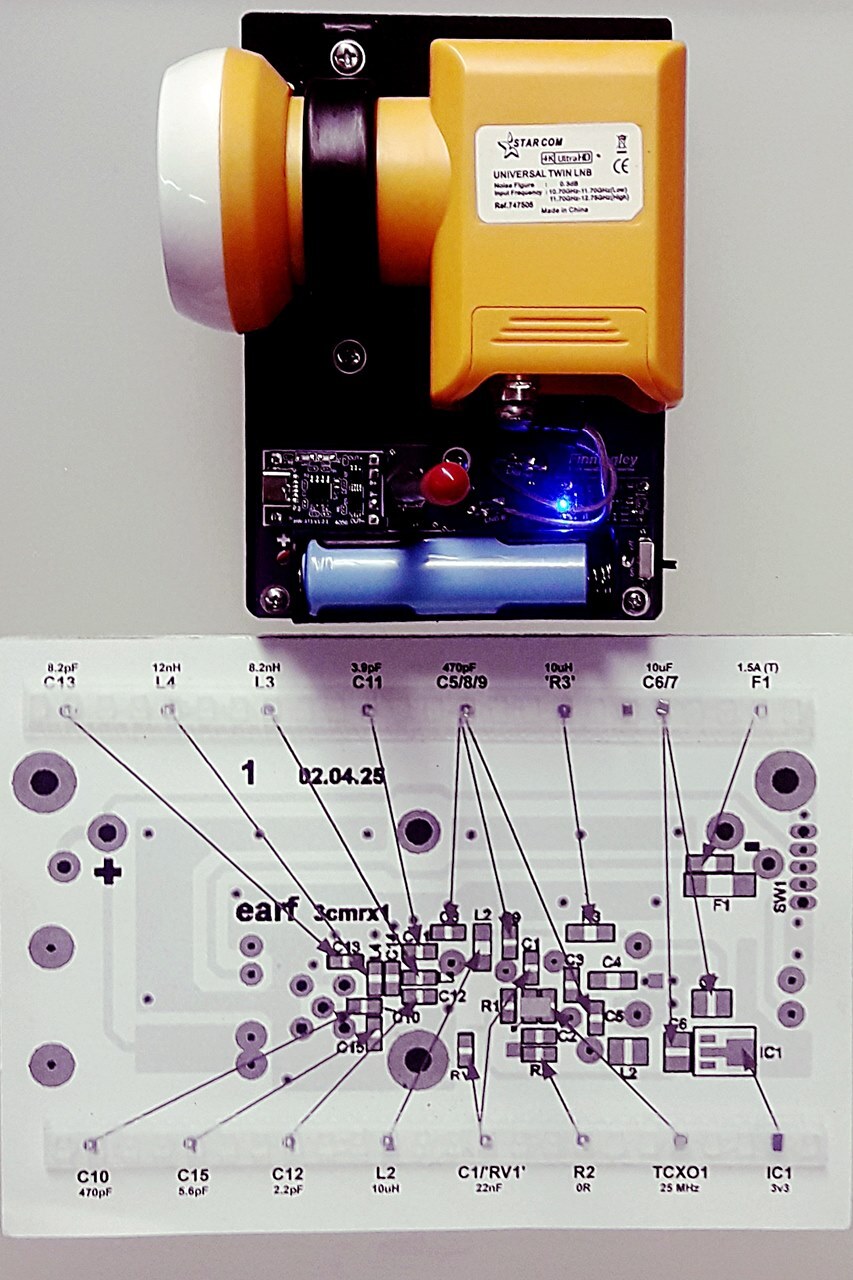
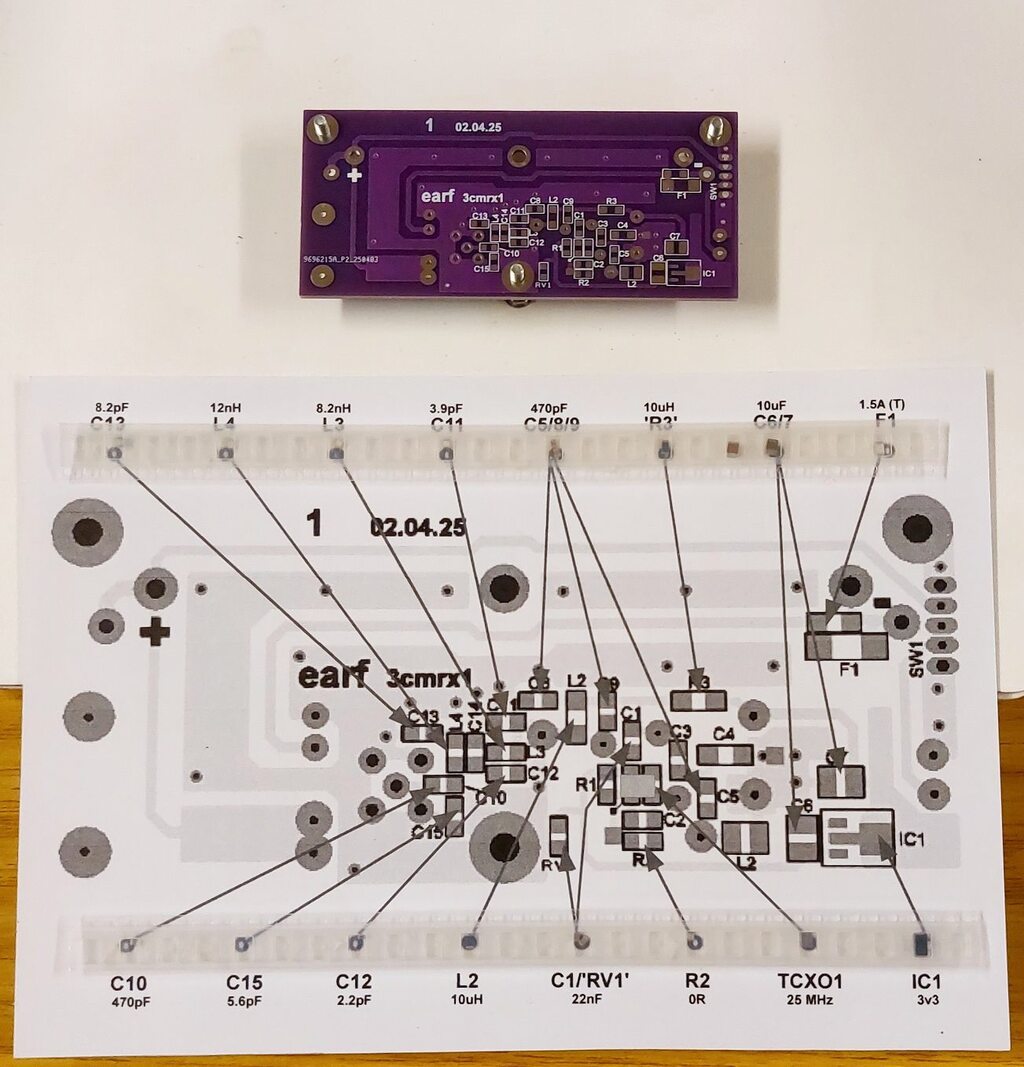
All these extra requirements add much more complexity than originally envisaged, but here again Aliexpress came to the rescue. Fully built small Li-ion cell charger/protection pcbs are ludicrous cheap, as are boost converters to provide a suitable supply voltage for the LNB. These have therefore been used on the final design, as shown here:
Several home etched pcbs to this design have been produced and built up, all without problem, and a batch of 50 boards ordered from jlcpcb.
Some modification work is required to the dual output LNB to enable one of the outputs to become the tcxo input route:
Although the internal xtal doesn’t strictly need removing, it should be in this project because it would otherwise impair tcxo frequency stability. The motherboard pcb allows for several methods of netting, which is why some of the circuit components around the tcxo have been greyed out here. The inductor L1 not only resonates out the capacitance of the connecting coax to the LNB, but also minimises the effect of load pulling of the tcxo frequency with the particular model called up.
Life per charge has been just over 4 hours for the units built to date.
One thing to note with the software modified Quansheng unit is the dead frequency range of 630 – 840 MHz, so it cannot be used to monitor the narrow-band QO-100 satellite output centred on 10489.750 MHz (unless a 26MHz tcxo is fitted to the converter, in which case the centre beacon will be down-converted to 349.750 MHz). Signals from the satellite are just audible via the converter without recourse to a dish, which may be of interest to some listeners.
Regarding the planned build session at the Finningley RT, kits will be available, but it’s a little too early to provide a price yet, but it will be at-cost or thereabouts. There’s a project web page which will be kept updated here:
http://www.earf.co.uk/3cmrx.html
If interested in assembling a converter, contact either of us as below:
Kevin Avery G3AAF – k_avery@tunstall.co.uk
Bernie Wright G4HJW – bernie@earf.co.uk